Understanding Dust Mite Allergies in Children
Dust mite allergies constitute the most significant subset of all allergies in India. According to this article, 69% of all Indian homes had at least one person suffering from allergies caused by dust mites! Yet, many people are unaware of the existence of dust mites and the problems they can cause.
So, what is a dust mite?
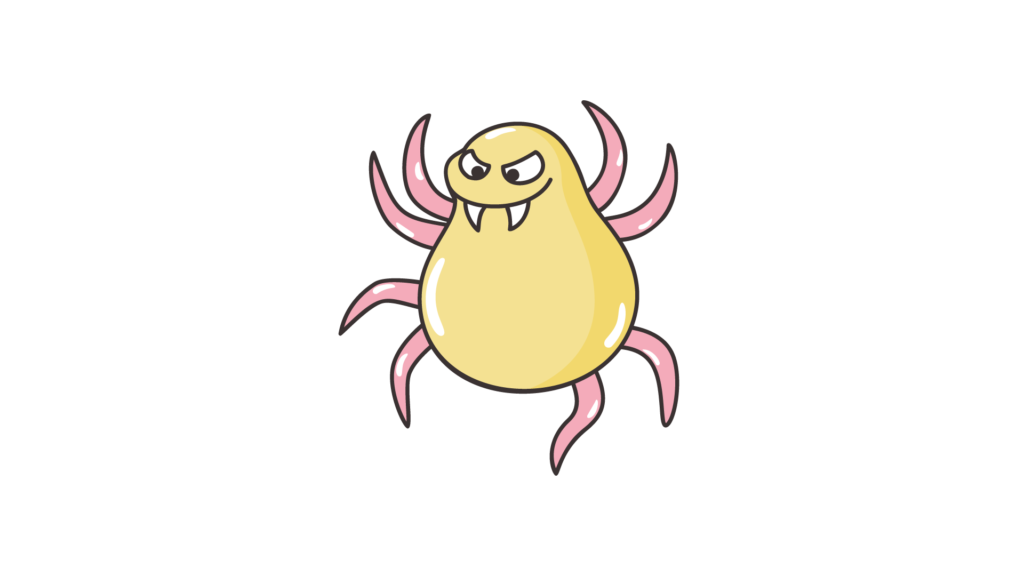
These critters are so small that the naked eye can’t see them and can only be seen under a microscope. They are related to spiders and have eight legs. Dust mites, as the name suggests, are found in dust indoors. Dust accumulates under the edges of objects and in the creases and folds of objects. The dust mite thrives in these situations (commonly found on rugs, bedspreads, pillows, and upholstered furniture), especially if it can find plenty of food. And what is their favorite food? You see, the outermost layer of skin is composed of dead tissue, and we are constantly descaling (🐍?), shedding our dead skin. The dust mite thrives on these scales.
So far, so good! Where does the allergy come from?
A dust mite has its own protein. Some react to this protein as if it is going to harm us, and our body tries to destroy it, creating an inflammatory reaction that harms us. We are genetically programmed to treat all proteins other than our own as foreign and to mount an inflammatory response against them. The same genes can cause a hypersensitive reaction in some individuals, causing allergy symptoms.
Dust Mite Allergy Symptoms
Like any allergy, different systems can be affected. Most commonly, the symptoms are:
-
- Allergic Rhinitis: sneezing, watery discharge from the nose, and a stuffy and blocked nose.
-
- Conjunctivitis: slight redness and itching in the eye
-
- Upper Respiratory symptoms like a scratchy throat, dry cough, and postnasal drips may cause spasmodic cough.
-
- Generalized: weakness, malaise, lethargy.
-
- Asthma-like symptoms: The bronchi (tubes that carry air in and out of the lungs) can become inflamed, irritable, and constricted. The child may have difficulty breathing, a tightness in the chest, or an audible wheeze.
If you have a family member who suffers from allergic disorders, then your child may be more likely to be affected by allergic conditions like dust mite allergy. If your child already has other allergic conditions, then s/he is more likely to suffer. Of course, the more dust mites in your house, the more likely household members will mount an allergic response.
Doctor, my child has some of these symptoms; please start some treatment.
There can be multiple causes for each of these symptoms. Once your doctor evaluates your child, she may advise specific investigations to prove the diagnosis. Even though dust mites are prevalent in every household, your child doesn’t need to have a dust mite allergy. After a thorough clinical evaluation, your doctor may advise some blood and skin tests that will probably confirm the diagnosis of dust mite allergy. It is essential to confirm the diagnosis, as treatment can be cumbersome and expensive.
Treatment Measures
There is no cure for dust mite allergies. One cannot change how the body responds to the mite protein that causes the allergic reaction. Immunotherapies are being developed but are in their infancy and are very expensive.
Our treatment strategies are essentially prevention and symptomatic treatment.
How to Reduce Dust Mites
We aim to decrease the exposure to dust mites by:
-
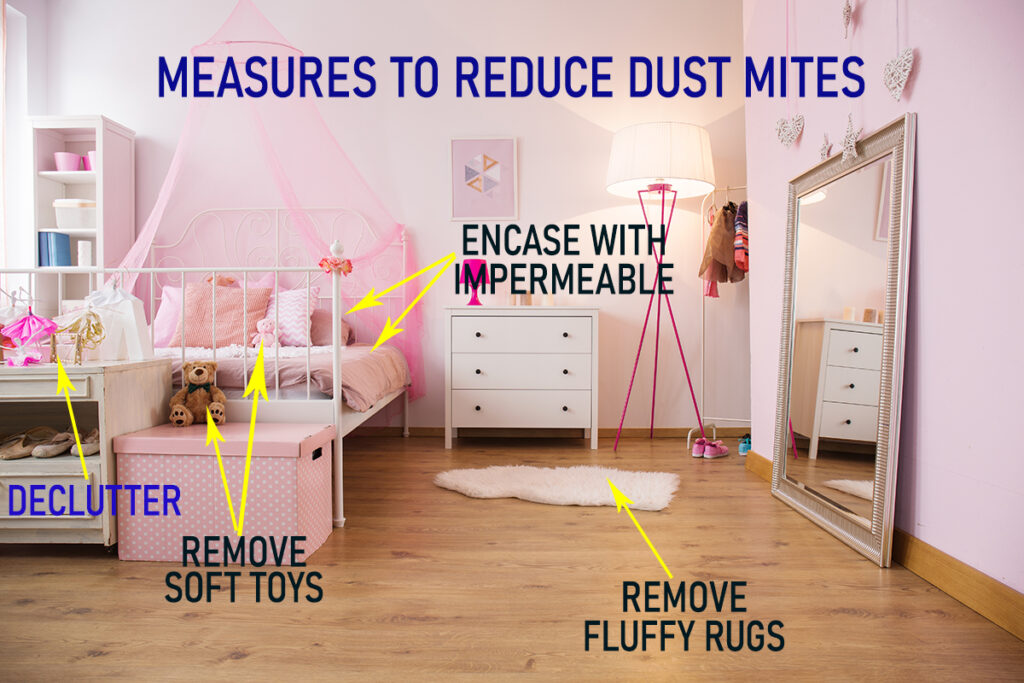
- Barriers: Since dust mites thrive in the nooks and crannies offered by upholstery, mattresses, and pillows, we try to encase our bedding with impermeable covers. Some product links on this page go to Amazon. If you buy through one, the clinic may earn a small commission at no extra cost to you. It never changes what we recommend.There are many available on Amazon and other retailers. This link is only a pointer to one of the many available. Remember to buy zippered protectors only.
-
- Remove carpets, rugs, excess pillows, and soft toys from the room where the child with allergies sleeps.
-
- Vacuum cleaning can reduce the dust mite reservoir significantly. Ensure your child does not enter the room being vacuum-cleaned during the process and for a couple of hours after the vacuuming. If possible, put HEPA filters in the vacuum cleaner to avoid spraying dust mites into the air during cleaning.
-
- Expose the objects in the room to as much direct sunlight as possible. This kills dust mites. You can use special chemical agents to kill dust mites on carpets that cannot be removed, but this is a temporary solution at best.
-
- Dry clean all linen. If not possible, tumble dry at temperatures of at least 55 °C for at least 20 minutes.
-
- If none of this is possible, freeze your linen. It does a great job of killing mites.
-
- Lower humidity using dehumidifiers: If you keep humidity levels <50% for at least 22 hours daily, dust mites stop growing or significantly reduce their multiplication. Air conditioners also reduce humidity. Monitor humidity levels in your home. There are many available on Amazon at different price points.
Symptomatic Treatment
The specific treatment for the allergic manifestations will depend on the actual type of allergy. Your doctor may advise the following:
-
- Skin allergies: anti-allergenic ointments, oral medications
-
- Sniffles and upper respiratory symptoms: nasal sprays, oral medications, and other medications as per symptoms. Some children benefit from long-term medicines. Specific immunosuppressants may have a role in the future; however, they are currently unavailable or too expensive.
-
- Asthma-like symptoms: inhalers, oral medications.
FAQs
1. Can dust mite allergies cause skin or stomach symptoms in children?
Yes. Dust mite allergies can cause not only respiratory symptoms like sneezing and congestion but also skin issues such as itchy rashes or eczema flare-ups. Some children may also experience stomach discomfort if their allergic reaction is strong.
2. Are dust mites common in most homes?
Yes. Dust mites are present in almost all homes, especially in warm and humid environments, such as those found in coastal areas across India. They thrive in bedding, mattresses, carpets, and upholstered furniture.
3. What are effective ways to reduce dust mites indoors?
Common measures include using allergy-proof covers on bedding, washing bedding weekly in hot water, keeping indoor humidity low (below 50%), removing carpets if possible, and regular vacuuming with a HEPA filter vacuum.
4. Can dust mite allergies be mistaken for frequent colds or sinus infections?
Yes. Dust mite allergy symptoms often mimic common cold or sinus infection symptoms, like nasal congestion and coughing. If symptoms persist or do not improve with usual treatments, allergies may be the cause.
5. How are dust mite allergies diagnosed?
Diagnosis is usually based on medical history, symptom patterns, and allergy testing, such as skin prick tests or blood tests to detect sensitivity to dust mites.
6. Do dust mite allergies worsen asthma or eczema?
Yes. Dust mite allergens can trigger or aggravate asthma attacks and eczema in sensitive individuals.
7. What treatment options are commonly recommended for dust mite allergies?
Treatment often includes avoiding exposure, taking antihistamines or nasal corticosteroids, and, in some cases, allergy immunotherapy (allergy shots or tablets) to reduce sensitivity.
8. Are allergy medications safe for children?
Most allergy medications are safe for children when used as prescribed by a healthcare provider. Always consult a doctor for appropriate treatments based on your child’s age and health.
This post has been written by Dr Ankita Bhandari & Dr Rajesh Nathani. Please feel free to comment below for any doubts, questions, or general health inquiries.
Related reading: When a cough and cold just won’t go away