Updated October 14, 2026 · Written by Dr. Neeta Nathani, pediatrician, Nathani Clinic, Chembur, Mumbai
Both – a one-word answer! In India, children get oral polio drops (OPV) at birth and at every Pulse Polio campaign, and the injectable polio vaccine (IPV) in early infancy with boosters. The injection gives the child strong personal protection against the disease. The drops also protect the community by stopping the virus in the gut. Together they keep India polio-free.
Is India still polio-free?
Yes. India’s last case of polio from the wild virus was a child in Howrah, West Bengal, on 13-Jan-2011. The WHO certified India and the rest of the South-East Asia region as polio-free on 27-Mar-2014. At one time India carried most of the world’s polio cases. It took the Universal Immunization Programme, years of Pulse Polio drives and lakhs of health workers to get here.
This is a stellar success of our immunization program. Our health workers faced almost insurmountable difficulties: a terrible climate, poor infrastructure and communication, and families with little access to schooling or health care, many of them wary of vaccines. Yet they soldiered on and, with generous international aid, brought diseases like smallpox and polio, which once killed and maimed hundreds of thousands, to an end.
Polio still circulates in two countries, Afghanistan and Pakistan, and a traveler can carry it across a border in a day. Until it is gone everywhere, every child in India still needs full protection.
What is polio, and why does it still matter?
Polio is a viral infection that enters through the mouth, multiplies in the intestines and can spread to the spinal cord. In a small share of infected children, it causes sudden, permanent paralysis, most often of a leg. There is no cure once paralysis sets in. Vaccination is the only protection.
Most parents in Mumbai today have never met a child with polio. That is the vaccine’s success, not a sign the disease has stopped mattering.
How is the polio injection (IPV) different from the drops (OPV)?
| Injection (IPV) | Drops (OPV) | |
|---|---|---|
| What it contains | Killed (inactivated) virus | Weakened live virus |
| Protects your child from paralysis | Very well: about 99% after three doses | Well, after several doses |
| Stops the virus spreading through the gut | Only partly | Yes, strongly |
| Can it ever cause polio? | No | Very rarely (see below) |
| How it is given | Injection in the thigh or arm | Two drops by mouth |
Because each does a job the other does less well, India uses both.
My child has had all the polio injections. Do they still need the drops?
Yes, please give it to them. The injection protects your child’s nerves, but the virus can still pass through a vaccinated child’s gut and reach a child who isn’t protected. The drops build immunity right in the gut, where polio enters, and so block that chain. Pulse Polio drops are free, safe on top of many earlier doses, and part of how India stays polio-free.
I gave every Pulse Polio dose to my own children when they were young, and I would urge you to do the same.
Which polio doses does Nathani Clinic recommend, and when?
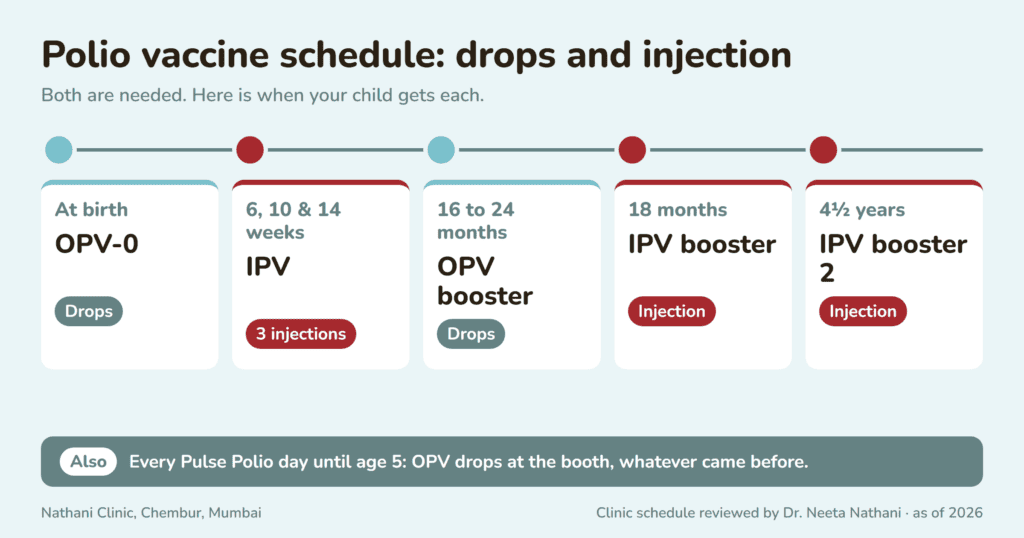
As of 2026, the clinic follows the schedule on our Vaccinations page, which is in line with the Indian Academy of Pediatrics (IAP):
- At birth: OPV drops (OPV-0).
- 6, 10 and 14 weeks: IPV injection, usually in the same combination shot as DPT.
- 16 to 24 months: OPV booster drops.
- 18 months: IPV booster.
- 4½ years: second IPV booster.
- Every Pulse Polio day until age 5: OPV drops at the booth, whatever other doses your child has already had.
The government schedule at public health centers uses OPV drops at birth, 6, 10 and 14 weeks, with a smaller dose of IPV given into the skin (fractional IPV) at 6 and 14 weeks. Both routes protect your child. If your child started on one, bring the card, and we will work out the rest. The full table is on our immunization schedule page.
Can the oral polio vaccine cause polio?
Very very rarely. The US CDC estimates about one case of vaccine-related paralysis for every 2.4 million doses of OPV given, mostly after the first dose. A child who has already had the IPV injection is protected from this.
There is a second, separate risk. Where many children are unvaccinated, the weakened virus from the drops can pass from child to child for months and slowly regain the ability to paralyze. This is called vaccine-derived polio. It is the reason the world changed vaccines in April 2016. The type-2 part was removed from the drops (trivalent OPV became bivalent OPV), and the IPV injection was added to protect against type 2. Full vaccination of every child keeps this risk near zero.
Why does my child need so many doses of the drops?
In Indian conditions, frequent diarrhea and other gut infections can stop a single dose of drops from “taking”. Repeated doses make sure every child’s gut is protected, and campaign days reach the children who missed their routine doses. Extra doses of OPV do not harm a child.
My child is unwell. Should we postpone the polio vaccine?
A cold, a mild cough or a low fever is not a reason to delay. For a high fever or a child who is clearly ill, we postpone the injection by a few days. Drops can usually still be given during diarrhea, but that dose may not count. We may repeat it once your child is well. If you are unsure, message us before the visit.
When should I call Nathani Clinic on the same day?
- Your child suddenly can’t move or stand on a leg or arm, or a limb goes floppy, at any time. This is an emergency.
- A fever above 39°C after a vaccination, or one that lasts beyond 48 hours.
- Inconsolable crying for over 3 hours after an injection.
Call: 98676 94813 · WhatsApp: +91 22 4006 0134
Related reading: DPT vaccine: painless or painful? · Can BCG vaccine be given at another site?
Written by Dr. Neeta Nathani, pediatrician, in practice since 1991, Nathani Clinic, Chembur, Mumbai. Reviewed October 2026.
Sources: WHO South-East Asia Region, “Keeping the polio virus at bay” (certification 27-Mar-2014; last case 13-Jan-2011, Howrah) · Ministry of Health and Family Welfare, Government of India, Pulse Polio Programme · IAP Advisory Committee on Vaccines and Immunization Practices, Recommended Immunization Schedule (2023), Indian Pediatrics, February 2024 · US CDC, Epidemiology and Prevention of Vaccine-Preventable Diseases (Pink Book), Poliomyelitis chapter.