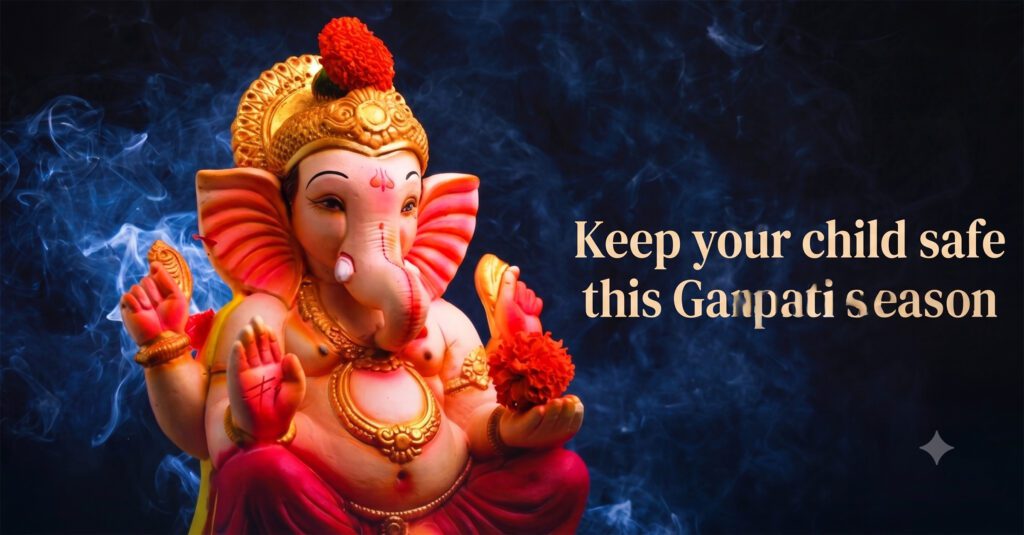
When is Ganesh Chaturthi in 2026, and which day is the immersion?
Ganesh Chaturthi falls on Monday, 14 September 2026. Families in Chembur bring the idol home that morning and keep it for one and a half, three, five, seven or ten days. The ten-day immersion — Anant Chaturdashi, the day of the big processions to Chowpatty and the local ponds — is Friday, 25 September 2026.
The two days that need the most planning where children are concerned are the first day, when the house is full of visitors and open flames, and immersion day, when there are crowds, water and very loud music. Those two days are the basis of almost everything that follows below.
How do you stop a child from getting separated in the crowd?
This is the most common festival emergency parents call us about, and it is almost entirely preventable. Do four things before you leave the house.
- Photograph your child that morning: in the clothes they are actually wearing. If you have to describe them to a police officer, you will hand over a phone instead of struggling to remember.
- Write your mobile number on the child: a band on the wrist, a card in the pocket, or simply your number written on the inside of the forearm with a ballpoint pen. Put two numbers, not one — yours and one other adult’s.
- Agree on a meeting point: do it before you enter the crowd, and point at it. For a child who cannot read a landmark, the instruction is instead: stay exactly where you are and shout for me. Rescuers locate a child who remains still in just minutes.
- Decide who is holding whom: one named adult per small child, holding the child’s hand, for the whole outing. “We are all watching them” is how children get lost.
Children under five do better carried or in a proper carrier than walking. Shoulders look fun, but put a child’s head at the level of trays, poles and lit sparklers. Leave the pram at home — you cannot steer one in a procession, and a child at ankle height in a moving crowd is not a safe place to be.
And if you are getting there on a two-wheeler, the festival changes nothing about the dangers of carrying a child as a pillion rider, except that the roads are more crowded than usual.
How should you respond during the first five minutes if a child goes missing?
- Do not all move: one adult stays at the exact spot. That is where the child was last with you, and it is where they will come back to.
- Send for help at once: go to the mandal’s volunteers or the nearest police point immediately, not after ten minutes of searching yourselves. The big Chembur and Mumbai mandals have volunteers, a help desk and a public address system, and they are used to this.
- Give the description in a fixed order: the child’s name, age, height, the colour of the shirt and of the footwear. Show the photograph.
- Ask for the announcement over the loudspeaker: it works better than any amount of walking around, because a child who hears their own name usually stops moving.
Teach an older child one sentence to say, and practise it before you go: “I am lost, my mother’s number is …” Teach them who to say it to — a police officer, a mandal volunteer in uniform, or a woman with her own children.
How loud is too loud for a child’s ears?
Is it loud enough that you have to shout to be heard by someone standing an arm’s length away? That is the practical test, and a DJ wall or a dhol-tasha pathak beats it as easily as a house of cards in the wind. The World Health Organization’s 2022 standard for safe listening at venues and events sets the ceiling at an average of 100 decibels for adults; a child’s ear is smaller, closer to the source when carried, and gets no extra protection from being young.
Damage from noise is not always felt at the time and it does not repair itself. What protects a child is distance, not tolerance.
- Stand back: every few metres away from the speaker helps. Watching the procession from the side of the road, or from a balcony, is a genuinely different exposure from walking in front of the truck.
- Infants have no business near a DJ system: none at all. If the baby is under one, enjoy the mandal in the morning, not at night.
- Ear muffs: the kind sold for children are cheap and they work. Cotton wool does very little.
- Watch for the warning signs afterwards: ringing in the ears, or the child saying sounds are muffled. If either is still there the next morning, have the ears checked by your ENT surgeon, or call Dr. Neeta Nathani and we will arrange your consultation.
Is it safe to take a child near the water on immersion day?
To watch, yes. Into the water, no — not even ankle deep, not even holding your hand, not even at an artificial immersion pond.
Drowning does not look like drowning. There is no shouting and no splashing; a child in trouble goes quiet and goes under, often within twenty seconds and often within touching distance of adults who did not notice. At Girgaum, Dadar and Chowpatty the sand shelves away suddenly, the tide moves, and on immersion night the water is crowded, dark and full of debris. The rocks and the steps at the ponds are slippery with silt.
The one rule that matters
One adult is assigned to one child, is within arm’s reach, and is not on their phone. Immersion is a photograph everybody wants to take. Decide in advance who is taking it and who is holding the child, and do not let it be the same person.
If a child does go into the water — even briefly, even if they seem completely fine afterwards — and they cough, retch, or are unusually sleepy or breathless in the hours that follow, they need to be seen at the earliest. Take them to the nearest Casualty, or to the Emergency Room at Surya Hospital and ask for Dr. Neeta. Do not wait to see how the night goes.
Afterwards, if anyone has waded in flood water or immersion water: wash the legs with soap and clean water, cover any cut properly, and watch for fever, severe muscle pain or red eyes over the next two to four weeks. This is the same caution we give at the end of every Mumbai monsoon. leptospirosis, the infection that follows wading in Mumbai’s monsoon water, is treatable, and is dangerous and even fatal when it is missed. Please do not give a child a preventive antibiotic on your own advice or a chemist’s — the dose and the choice of drug depend on age. Call us.
Which children need a plan made before you leave home?
- A child with asthma: incense, camphor, dhoop, crowd dust and the smoke from firecrackers are all triggers. Carry the reliever inhaler and the spacer — in your bag, not at home — and give the preventer on time that week without fail.
- A child with epilepsy: two things provoke seizures during festivals, a missed dose and a short night. Keep the medicine on its usual clock even when the day is not usual, and make sure the child still gets a full night’s sleep.
- A child with a heart condition, or any chronic illness: ask us the week before, not the night of the event. Most of what you want to do is fine; we would rather say so in advance.
- An autistic child, or any child who finds noise and crowds hard: ear defenders, a visit at a quiet hour rather than at night, a planned exit and a rehearsed sentence for what happens if it gets too much. A short, calm darshan is worth more than a long, distressing one.
- A baby under six months: skip the processions altogether. There is nothing there for the baby and a great deal of noise and infection.
- Any child running a fever that day: stay home. It is ten days long; there will be another evening. If you are unsure how worried to be, we have written about when a fever is worth calling us about.
Is festival food safe for children?
Freshly steamed ukadiche modak eaten warm is one of the safest things your child will eat all month. The trouble is not the food, it is the standing.
- Two hours is the limit: cooked food, khoya sweets and cut fruit that have sat out at room temperature for more than about two hours in September’s humidity should go to the birds, not to a four-year-old. Prasad that has gone round a full aarti and then sat on the table all evening is exactly this.
- Whole nuts, dry fruit and hard sugar sweets can choke small children: under about four years, chop them fine, much smaller than the size of the child’s thumb, or leave them out. The same goes for chunks of dry coconut.
- Be careful with what you buy from the street: during the festival week that means gola, cut fruit with masala, sugarcane juice, and anything made with water or ice you have not seen. With this heat and humidity, it is the peak of the season for stomach infections.
- Hand washing before prasad, every time: soap and water if there is any, sanitiser if there is not. It is worth showing a small child how to wash their hands properly once, before the festival week.
If loose motions do start, the answer is oral rehydration solution, not an energy drink — made up properly and given in small sips over the day.
What about diyas, camphor, sparklers and firecrackers?
The aarti thali is at exactly toddler height, and a camphor flame is nearly invisible in a bright room. Put the thali down out of reach the moment the aarti ends, and keep the matchbox and the oil away from the decoration where small hands are already going.
- Dress children in cotton: on aarti days especially. Synthetic festive clothes melt onto the skin and fuse with it, intensifying the burn, instead of burning away; a dupatta or a long kurta hem near a lamp is the usual story. Clothes should be comfortably loose, but not flowing and flapping.
- Sparklers: for children over about eight, held at arm’s length, one at a time, outdoors, with an adult standing there and a bucket of water next to them. Never in a crowd, never near a stack of clothes or a decoration.
- For a burn: cool running water over the burn for a full twenty minutes, then cover it loosely with a clean cloth. Nothing else on it — no ice, no toothpaste, no ghee, no haldi. Then call us. The same first aid applies to the scalds that are the commonest burn we see in children all year round.
Straight to a hospital, not to the clinic
A burn larger than the child’s own palm, any burn on the face, the hands, the feet or the genitals, any burn that has blistered widely, or a child who has inhaled smoke and is coughing or hoarse.
How do you handle Mumbai’s September weather during a procession?
Hot, humid, wet under foot, and full of mosquitoes. A procession is several hours of standing and walking, and children get dehydrated faster than adults do because they are smaller and because they will not stop to drink.
- Carry water and offer it on a clock: every twenty minutes, whether or not the child asks. Thirst arrives after dehydration has started, not before it, and how much water a child actually needs surprises most parents.
- Footwear that grips: wet tiles, silt on the promenade and slippery steps cause more injuries on immersion day than anything dramatic. Sandals with a strap, not slip-ons.
- A light raincoat, not an umbrella: an umbrella in a crowd is a spoke at somebody’s eye level.
- Mosquito protection: dengue peaks in Mumbai after the monsoon, and standing decorated water — including the pot at the foot of the idol — is a breeding site. Empty it, and use a repellent that is appropriate for your child’s age.
What should be in the bag you carry that day?
- Water, and two sachets of oral rehydration solution
- Your child’s own regular medicines — inhaler and spacer, anti-epileptic, anything daily
- Paracetamol, at the dose we have written for your child
- A few plasters, a clean gauze pad and an antiseptic
- Wet wipes and a hand sanitiser
- One full change of clothes for a child under six
- A small torch — immersion crowds go on well past dark
- The identity band or card, and a charged phone with a power bank
- Our numbers saved in the phone, before you leave
Are painted plaster idols a health problem for children?
They are worth a thought. Plaster of Paris does not dissolve well, and the bright chemical paints used on many idols can contain heavy metals, including lead. That matters for a small child in two ways: hands that have been on a freshly painted idol and then go into a mouth, and immersion water that children are tempted to play in.
Nothing here needs alarm. Wash hands after handling the idol and before eating, keep children out of the immersion water, and if you are choosing an idol, a shadu clay one with natural colours is kinder to a toddler and to the creek both.
When should you call us the same day?
Call us the same day if
- Your child went into the water, and afterwards coughs, vomits, is breathless or is unusually sleepy — even if they seemed fine when they came out
- Breathing is fast or difficult, or you can hear a wheeze
- A burn is larger than your child’s palm, or is on the face, hands, feet or genitals
- There is a head injury followed by vomiting, confusion or unusual drowsiness
- Anything has gone into an eye, or an eye is painful, red and watering after a firecracker
- Bleeding has not stopped after ten minutes of firm, continuous pressure
- Ringing ears or muffled hearing is still there the next morning
- Fever, severe muscle pain or red eyes in the two to four weeks after wading in flood or immersion water
- Loose motions with no urine passed for eight hours, or a child too tired to drink
Call: 98676 94813 · WhatsApp: +91 22 4006 0134
Phone and WhatsApp are answered Monday to Saturday, 8:00 AM to 8:00 PM. Consultations are Monday to Friday 4:30–8:30 PM, and Saturday 11:30 AM–1:00 PM and 4:30–8:30 PM.
If a child is unresponsive, is not breathing normally, or has a burn or an injury that frightens you, do not spend time telephoning — go straight to the nearest hospital emergency department and call us from there.
So should a child go at all?
Of course. A child who has stood in front of a decorated mandal with a plate of modak in their hand at the age of five remembers it at fifty. None of this is an argument for staying indoors; it is an argument for ten minutes of planning before you step out.
Write your number on the child, hold a hand, stay out of the water, stand away from the speakers, and eat the modak while it is warm.
Ganpati Bappa Morya!
The same short list of precautions carries over to the rest of the year’s festivals — we have written separately about keeping a child safe at Holi and about having a fun but safe Diwali.
About this article
Written by Dr. Neeta Nathani, MD, pediatrician, in practice since 1991, Nathani Clinic, Chembur, Mumbai. Reviewed for surgical and injury advice by Dr. Rajesh Nathani, pediatric surgeon, in practice since 1989. Published 10 September 2026.
General guidance for families in Mumbai; it does not replace seeing a doctor about your own child. Noise limits are from the World Health Organization’s global standard for safe listening at venues and events, 2022.