Baby Poop
New parents are very fussed about whether their bundle of joy is pooping normally. And why not? After all, the hallmarks of health in a human being are eating well and evacuating both poop and urine well.
We get it. As a new parent, the contents of a diaper can quickly become the biggest mystery of your day. It’s natural to worry about every newborn’s poop color and texture. Rest assured, your baby’s poop is a crucial, if a stinky, health report card. Learning to “read” this baby poop guide is one of the most valuable skills you’ll develop!
Your Baby’s Secret Signal
Why Fecal Assessment Matters?
Your baby can’t tell you with words if their tummy is happy or if they are getting enough to eat. That’s why their poop is so important! It provides direct clues about their digestion, hydration, and overall health. Paying close attention helps you spot changes early, giving you peace of mind and letting you catch little issues right away.
What is normal?
Please throw out any idea of a single “perfect poop.” There’s an enormous range of what’s normal for babies, and it changes all the time! What matters most is what’s normal for your baby right now. We’re here to help you understand the common, healthy range of baby poop consistency so you can relax about the everyday changes and flag the few, rare colors that need a call to the doctor.
There is a wide variation in the amount of poop a normal baby can produce, and many factors are involved. The most crucial factor is whether the child is breastfed or formula-fed. There are many other factors, such as how much the baby takes, how quickly the baby feeds, and the intrinsic differences between babies.
The Newborn Stage: Meconium and Transitional Poop Colors
Meconium: The Primordial Stool
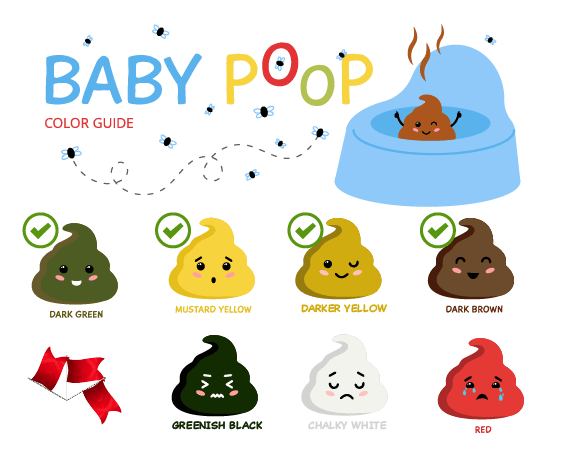
In the first day or two after birth, you will see meconium. This is the first kind of poop, and it looks like a thick, sticky, dark greenish-black tar. It’s made up of everything your baby swallowed in the womb—like amniotic fluid and old cells. Seeing this means their digestive system is open and working, which is a big deal!
Transitional Stools: A Moment of Metamorphosis
Once your baby starts taking in milk, the meconium begins to clear. This is when transitional stools appear. They are lighter—often a desaturated green or brownish-green—and much less sticky. You might notice they are runnier and may contain little grainy bits. This is a sign that their body is successfully switching over to digesting milk.
| Stool Characteristic | Breast-fed Infant | Bottle-fed Infant |
|---|---|---|
| Frequency | More frequent (but varies from several times a day to once in seven days) | Less frequent – typically once or twice a day |
| Color | Lemon yellow | Darker: yellowish brown or even brown. |
| Consistency | Usually soft, maybe loose, grainy, or even curdled | Pasty |
| Smell | Maybe slightly sweet | Strong smelling – more like adults |
Even if the child is exclusively breastfed or bottle-fed, there is still a wide range of stool types the baby may produce. There is no need to panic if there is a one-time change in the nature of stools, especially if the baby is otherwise doing well, feeding well, active, and passing adequate amounts of urine.
Decoding Baby Poop Color
Verdant Hues: The Green Conundrum
Green poop is perhaps the most common reason parents call us. Don’t panic!
Why it happens: Most of the time, it just means the poop traveled through the gut very quickly. The bile (which starts out green) didn’t have enough time to turn yellow/brown.
Common causes: A quick tummy bug, dietary changes if you’re breastfeeding, or sometimes even iron supplementation in formula.
An isolated green poo episode is entirely normal. If persistent, the child may pass green stool because of a Faulty Feeding Technique – Breast milk is let down in two phases – the first part is called “fore-milk” – this is thinner and full of lactose, and the latter part is called “hindmilk”, which is thicker and is rich in fat. If the baby does not latch properly, she receives more foremilk, which tends to hurry down the intestine (the sugar also increases the speed at which it comes down), resulting in loose, green stools.
Allergies
Medication Allergies
These can be medicines or supplements taken by the baby or the mother, like antibiotics or iron supplementation.
Food Allergies
Allergies to something that you have eaten. Usually, the baby will also have eczema or rash.
Spectral Aberrations: When Red, White, or Black Appears
While shades of yellow, brown, and green are OK, these three colors need attention.
White Or Pale Poop
Again, a single, pale poo is not concerning, but if persistent, it can be a matter of grave concern. You need to see your pediatrician immediately. This might be due to an infection or a problem with bile flow.
Black Poop
Definitely a concern unless your child is on iron supplements. It indicates digested blood.
Red Poop
Again concerning as it indicates fresh bleeding. You need to see your pediatrician immediately.
The Significance of Bilirubin Metabolism Or Why These Shades in Color?
All the colors you see are thanks to your baby’s liver. It processes a substance called bilirubin. If the liver works quickly, it turns green. If it works perfectly and the digestion is slow, it turns the lovely yellow/brown we expect. Color changes mean this processing speed has shifted.
Understanding Baby Poop Consistency
Constipation
Constipation is more common in children who receive formula feeds as opposed to breast-fed infants. The most common culprit is that the formula is not being prepared properly, with insufficient water added to make the feed. There is a lot of variation in infants’ stools, and many infants who are not constipated strain and become congested during bowel movements.
However, if any of these are present, your infant is more likely to be constipated:
- Strains and grimaces or cries out while passing stools.
- Takes a long time to pass stools.
- Stools are either pellet-like – “goat/rabbit stools” or really bulky (much more than what you would expect from a child of this age.
- The abdomen seems bloated.
- Maybe a ‘streak of blood’ is seen on the side of the stool.
Please visit your pediatrician to confirm and start the appropriate treatment.
Diarrhea
Characteristics of an infant who has diarrhea:
- Watery, runny poop.
- Passes stools frequently.
- Stools may come out explosively or in squirts.
- Maybe foul-smelling.
- May pass mucus or blood with stools.
- May have vomiting.
- May have a fever.
When to worry if your child has diarrhea?
The biggest worry: Dehydration, especially in newborns.
Look out for: Explosive poops and large, watery spills. If your baby is having diarrhea for more than a day, or if they seem tired, limp, or have fewer wet diapers, please call the doctor.
Mucus: The Viscous Intrusion
Do you see slimy, jelly-like mucus streaks in the diaper?
A little mucus is okay, especially if your baby is drooling a lot or has a stuffy nose (they swallow that mucus!).
If you see large amounts of mucus constantly, it might be a sign of gut inflammation, sometimes due to a sensitivity like a milk or soy allergy. Keep track and mention it to your doctor.
Infants On Weaning Foods
If weaning foods have been started, the child is more likely to pass stools that look more like adult stools. The frequency of motions will depend on the type of diet and the amount of water that the infant consumes.
Many times, the stools take on the color of what the child ate. e.g., if pureed carrots, they may look red or orange, if pureed beets, they may look red or purple.
Often, undigested food can be seen in stools if you have forgotten to properly puree the food. e.g., whole beans, pulses, or raisins. Please be very careful and only give food that is the right consistency and appropriate for the child’s age, as there is a risk of choking.
When to Call the Doctor About Baby Poop?
A. Persistent Atypia
If a change in color, texture, or frequency lasts more than a couple of days, and you are feeling uneasy about it, it’s always better to call your pediatrician (that’s your friendly doctor!). We’d rather hear about a benign change than miss something important.
B. The White Chalk Phenomenon (Acholic Stools)
As mentioned before, if the stool is pure white, pale gray, or the color of clay, it means there’s a serious blockage preventing bile from flowing. This needs immediate medical attention.
C. The Presence of Occult Blood
If you see a lot of red blood in the diaper, or if the poop is black and tarry (after the meconium stage), you need to talk to your doctor right away.
D. Severe Dehydration Markers
If diarrhea is present, watch for these signs of severe dehydration:
Fewer wet diapers than normal.
Sunken eyes or a sunken soft spot (fontanelle) on their head.
Lack of tears when crying.
Extreme fussiness or unusual tiredness.
Conclusion: The Digestive Dialect
Embracing Parental Observational Acuity
You are doing a fantastic job learning your baby’s unique language. By paying attention to this “digestive dialect,” you are becoming the most reliable health monitor your child has. Keep trusting your instincts!
I have written this book on constipation in children from infancy to adolescence. I see a lot of constipation, and almost all of them are children who have constipation secondary to both poor diet (in fiber) and poor toileting habits. Get a head start by avoiding constipation altogether! This book is free to read with a Kindle Unlimited subscription and has a nominal charge otherwise.




Excellent and very informative article
Thank you. Please keep suggesting what you would like to see and what topics are good for you.